Technology Report 2026
Big Tech Is Pouring Billions Into Nuclear Power… While Chips May Soon Use Tens of Times Less Energy
Spintronics, photonics, neuromorphic computing — and why AI needs ever more electricity
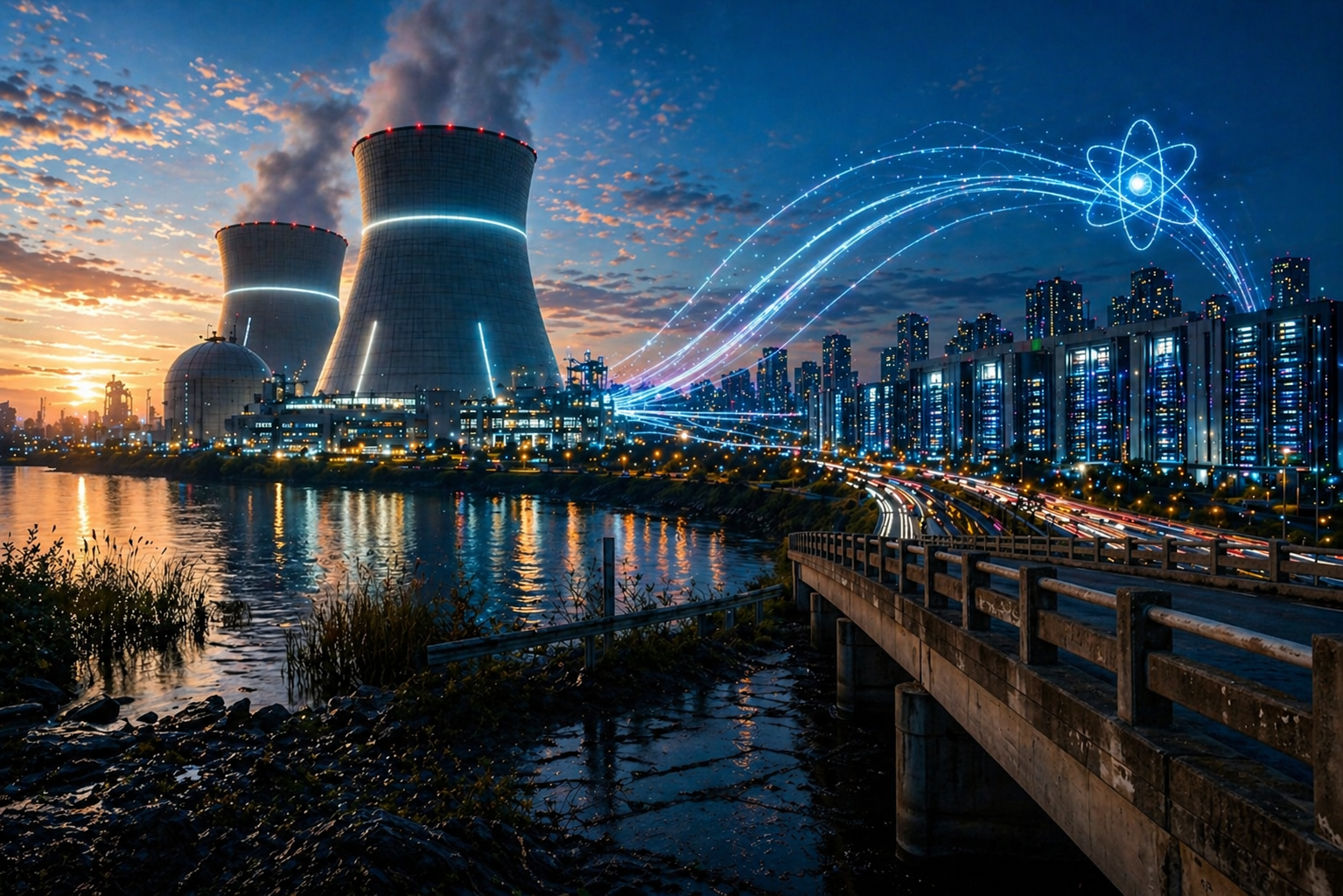
Microsoft and Constellation Energy are accelerating the project to restart Unit 1 at Three Mile Island.
It's the same island where, on March 28, 1979, Unit 2 spun out of control. For hours, operators struggled to understand what was actually happening, as radioactive steam was released into the atmosphere. The governor advised pregnant women and children under five to evacuate the five-mile zone around the plant. Within days, more than 140,000 people had fled the area.
The worst nuclear accident in U.S. history.
Today, Microsoft wants to use that place to power its servers. It's hard to imagine a better metaphor for our times.
Three companies are leading this race. Each in its own way. Microsoft is reviving a reactor remembered for catastrophe. Amazon buys entire power plants. Google signs contracts that lock in power for decades.
Big Tech is pumping billions into nuclear power not out of ideology, but out of brutal math.
Why Big Tech Is So Desperately Hungry for Electricity
Have you heard this one before? Computers use less and less energy… while the electricity bill rises faster than ever.
Imagine a data center as a city that never sleeps. Every ChatGPT query, every Face ID unlock, every Netflix stream wakes up thousands of servers. They start working. Heating up. Pulling power from the grid.
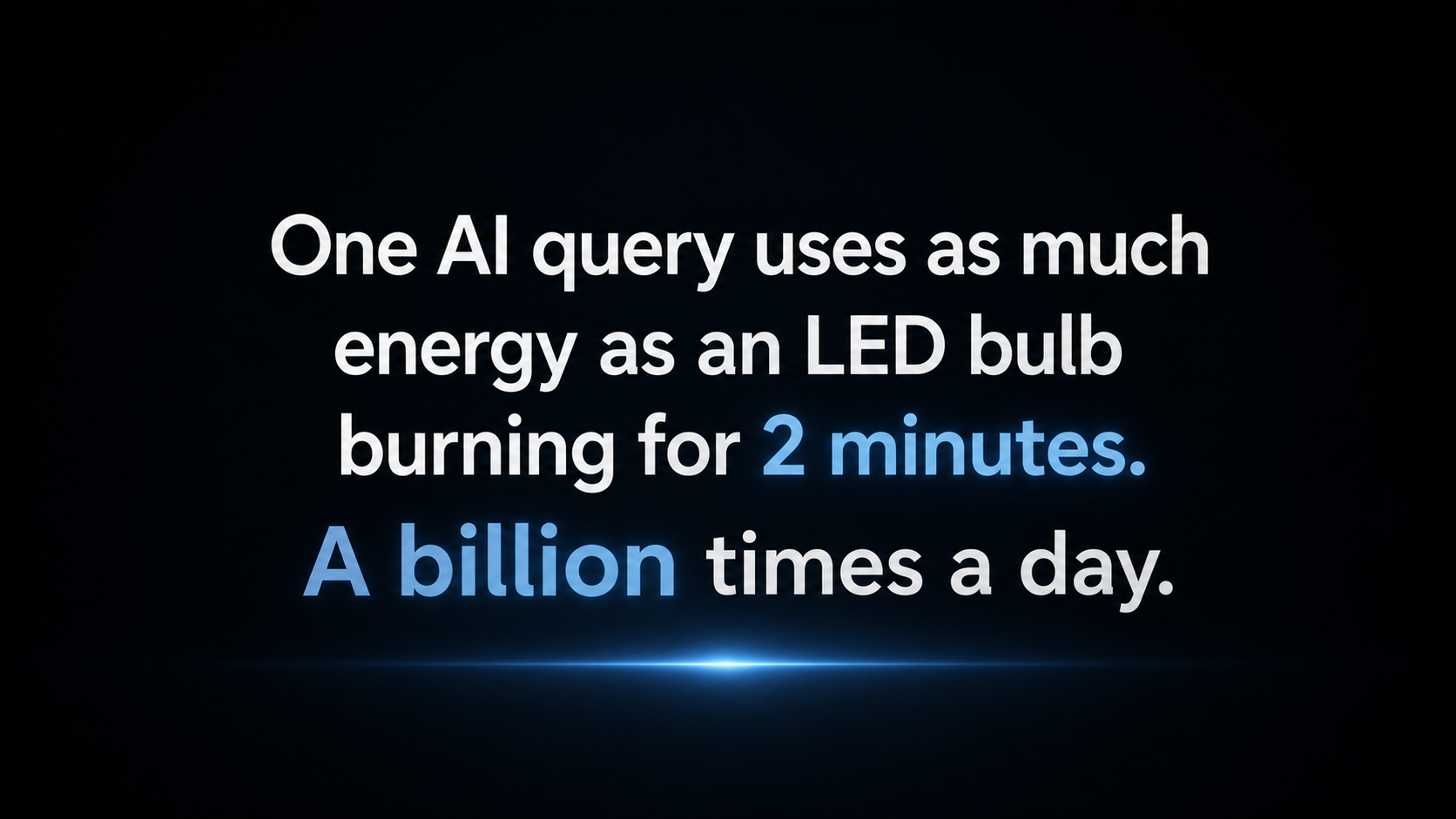
How much exactly? One ChatGPT query uses around 0.34 Wh.¹Source: Sam Altman, OpenAI (June 2025) — figure stated publicly by the company. Independent estimates (Epoch AI) are consistent with it. of energy. About the same as an LED bulb running for two minutes. Sounds tiny. Until you multiply it by billions of queries every day. Training one large AI model like GPT-4 consumed around 50 GWh²Source: Stanford HAI 2026 AI Index Report. Includes pre-training compute energy footprint. of energy.
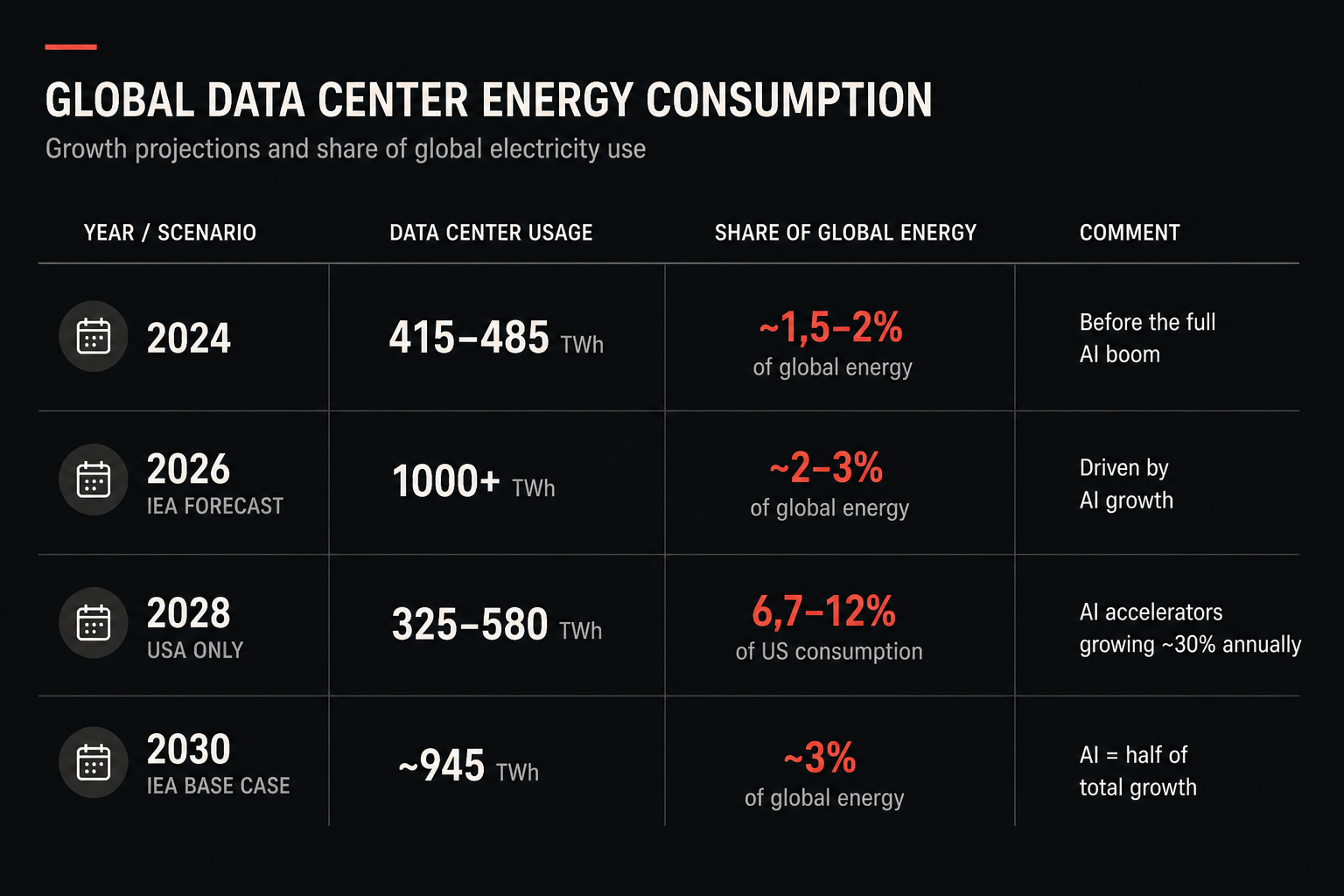
Infographic 1: Explosive growth in AI infrastructure energy demand (IEA forecasts)
If data centers were a country, they would already be the fifth-largest energy consumer in the world, somewhere between Japan and Russia. And that energy has to be available 24/7. Solar and wind don't guarantee that. Nuclear does.
WATCH: 3D visualization — the computing technologies of the future
Old Reactors vs. New Ones — The Quiet Energy Revolution
Old reactors were like giant apartment blocks. They took 10–15 years to build, cost billions, and were often completed late and over budget.
SMRs — small modular reactors — are in a different league entirely. Instead of building the whole facility from scratch on-site, you order factory-made modules and assemble them like Lego blocks on a foundation, so construction only takes 2–4 years instead of 15.
Why Salt Instead of Water
Old reactors use water under enormous pressure. Like a pressure cooker on steroids. When a pipe breaks, you have a problem, and Fukushima showed how big that problem can get.
Molten salt remains liquid at 600–700°C and does not require high pressure. An open pot instead of a pressure cooker. The system heats up and shuts itself down. It does not produce explosive hydrogen. And if temperatures rise too far, the salt drains into a storage tank and the reaction dies automatically. No electricity. No human intervention. Physics does the work.
What's Actually Happening — April 2026
These are not plans. These are construction sites.
Construction has begun in Oak Ridge. The first U.S. molten-salt reactor designed to deliver electricity to the grid. For Google and the Tennessee Valley Authority.
A giant battery that charges during off-peak hours and releases power when needed.
20-year PPA with Microsoft. Restart cost: $1.6 billion.
And it's not just the U.S. China is building more nuclear reactors than the rest of the world combined. The AI energy race is global.
But delivering electricity is only the first half of the problem. The second half sits exactly where that electricity gets consumed — inside every computer.
80 Billion Tiny Heaters
The hottest components are GPUs. Chips that once rendered video game graphics and now power every AI model on Earth. Every ChatGPT answer means trillions of calculations running through these chips.
A single GPU contains 80 billion transistors³Source: NVIDIA Technical Blog — Hopper Architecture In-Depth (H100 specification).. They switch on and off billions of times per second. Every switch releases a tiny amount of heat. 80 billion tiny heaters on one chip.
The second source of heat is less obvious. Today's transistors are so small that current leaks through them even when they are switched off. That's why data centers in Arizona are cooled by industrial systems consuming as much power as a small city.
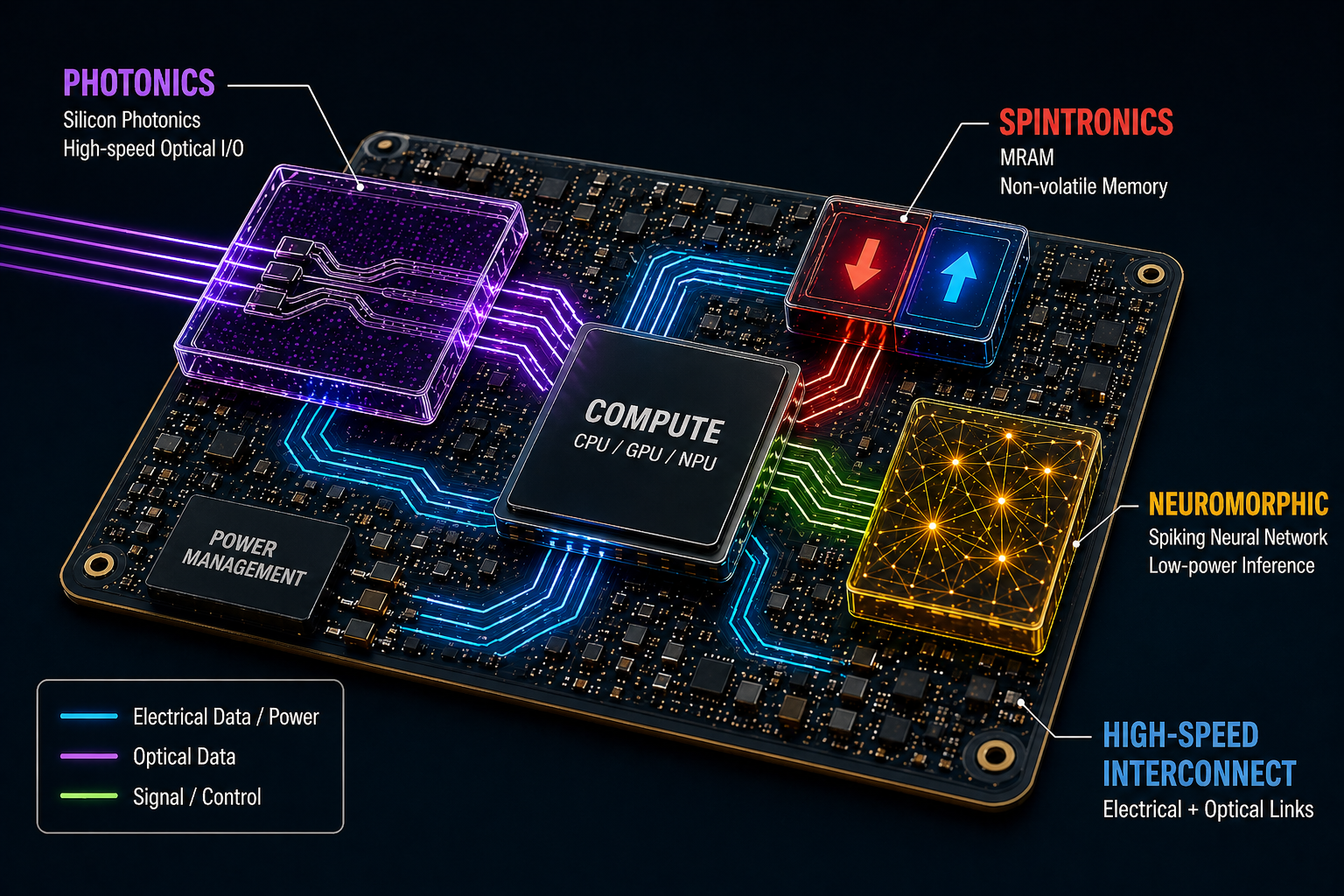
Architecture of the future chip: photonics, spintronics, and neuromorphic computing inside one system.
Spintronics — Memory That Survives After Your Phone Dies
What if your phone's battery died today, but the device still remembered everything after six months in a drawer? You turn it back on months later — and you're exactly where you left off.
Samsung entered the race in 2019. TSMC followed in 2024. The global MRAM market is expected to surpass $5 billion by 2030.
The principle is simple. Ordinary memory stores information with electricity — cut the power and it disappears. MRAM stores information magnetically. Once written, it stays. No power. No constant refresh.
That's why the biggest companies have been investing in it for years. In a conventional AI chip, data constantly runs back and forth between memory and processor — each trip consumes electricity and generates heat. Today, that movement costs more energy than the computation itself. MRAM can be built directly into the processor. The data no longer has to shuttle back and forth. For data centers, every percentage point of electricity saved means millions of dollars per year. And when Samsung starts taking something seriously, the market usually pays attention.
Silicon computes. Spintronics remembers.
Magnonics — Waves Instead of Electricity
Another branch of the same family is magnonics — information carried not by electrons, but by waves inside magnetic materials. Scientists at the University of Vienna shrank magnonic transistors from 2 millimeters to 50 nanometers in one decade. A 40,000-fold reduction.
But a chip is more than memory. It also computes. And computation devours most of the electricity in every AI system.
Photonics — Why the Last 30 cm of Your TikTok Still Runs on Electricity
The internet connection carrying this article already runs on light. Your TikToks, emails, online banking sessions — all of it travels through fiber optic cables beneath oceans at the speed of light. Until it reaches your router. Then the light turns back into electricity, runs through copper wires into your computer, heats up, and the fan starts screaming.
Lightmatter raised $400 million.⁴Source: Lightmatter press release, Series D, October 2024. in October 2024 and reached a $4.4 billion valuation. Lightelligence, Celestial AI, and Optalysys are playing in the same league. Hyperscalers are already testing the first photonic systems in production.
Photonics goes even further and attacks computation itself. Photons don't heat up along the way, and matrix multiplication — the thing AI does most often — consumes tens of times less electricity optically than electronically.
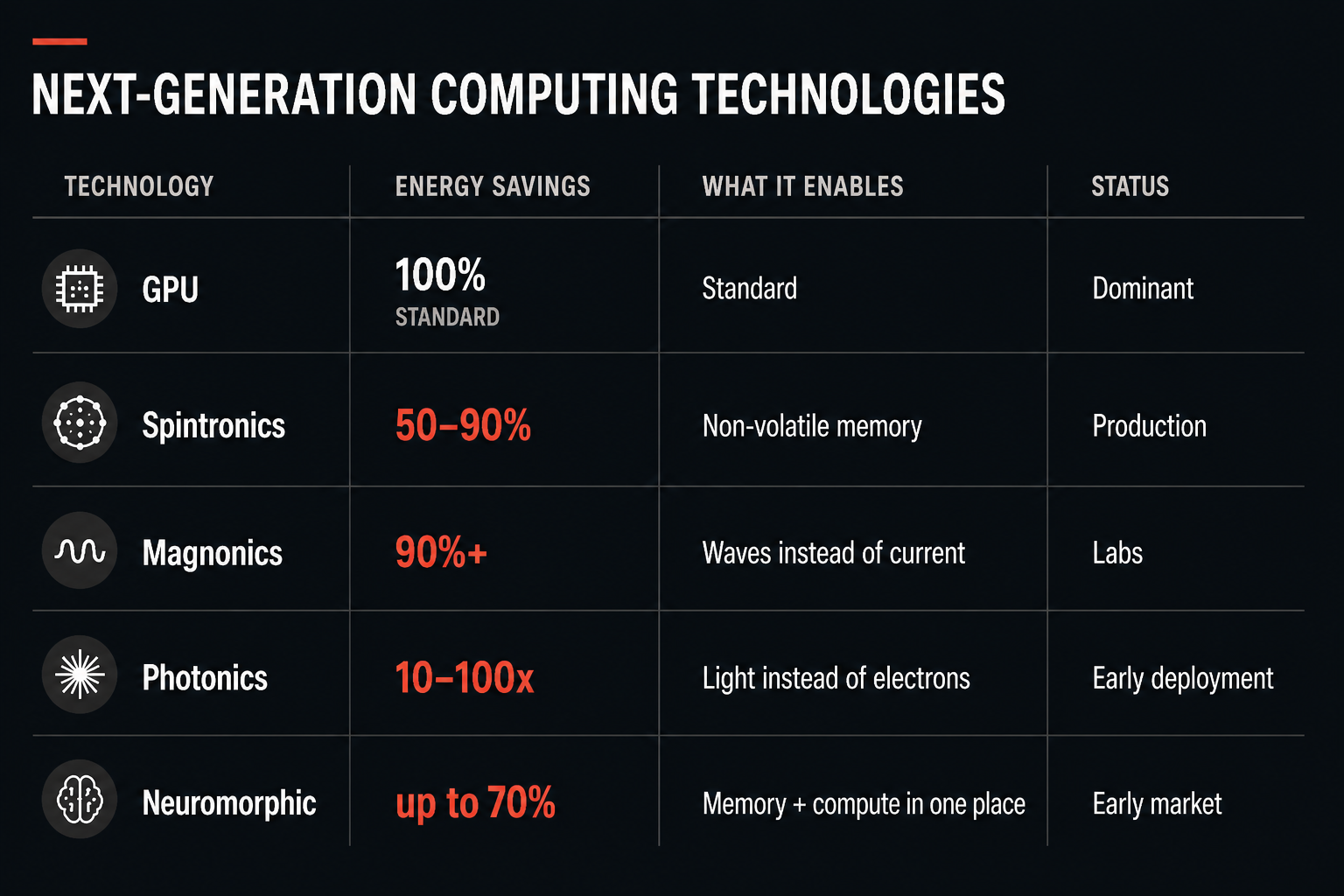
Infographic 2: Energy savings across next-generation computing architectures
Photonics solves computation. But today's chips never truly sleep. What if they could?
Neuromorphic Chips — The Chip That Decides Whether a Self-Driving Car Kills Someone
Your brain weighs around 1.5 kilograms and consumes roughly 20 watts. About the same as a light bulb. A supercomputer training ChatGPT consumes megawatts — about a million times more. Neuromorphic chips try to bring the brain's principles into silicon.
Intel showed Loihi 2 in 2021. IBM answered with NorthPole two years later. BrainChip already sells its processors to Ford and Valeo. NASA is testing the technology where failure costs more than money — in space.
Want a self-driving car that doesn't kill because of latency? You need a neuromorphic chip. A traditional GPU sends data to the cloud and waits for a response. By then, it's already too late. A neuromorphic chip processes the information locally, in 50 milliseconds. The same principle is used in hearing aids designed to last a week on a single battery.
From the Archives: When Efficiency Turned Into Greed
1865. England. William Stanley Jevons noticed something strange: steam engines became more efficient, but coal consumption didn't fall. It rose. Because suddenly it became profitable to use coal everywhere. Economists later called it the Jevons paradox.⁵Source: W.S. Jevons, The Coal Question (1865), via Yale Energy History archive.
That's exactly what's happening with artificial intelligence right now.
Nuclear power is the fuel for AI's expansion. Every new reactor becomes a license for larger models, more computation, and more queries per second — safely, reliably, for decades to come.
Spintronics, photonics, and neuromorphic chips are moving in the same direction. A chip that is 100 times more efficient doesn't reduce global energy consumption. It pushes AI into places where it doesn't exist today — into hearing aids, refrigerators, light bulbs, even wine corks.
This is not a story about saving energy.
Jevons paradox
- William Stanley Jevons, The Coal Question: An Inquiry Concerning the Progress of the Nation, and the Probable Exhaustion of Our Coal Mines (1865) — Yale Energy History
Nuclear power and Big Tech investment
- IEA — Key Questions on Energy and AI (April 2026)
- Kairos Power — Hermes 2 (April 17, 2026)
- TerraPower — Natrium (April 23, 2026)
- Reuters — Three Mile Island (March 2026)
- CNBC — DOE $1B loan
AI chip energy
- 80 billion transistors in a GPU: NVIDIA Technical Blog — Hopper Architecture In-Depth (H100 specification)
- Memory wall — energy goes to data movement: A. Gholami et al., AI and Memory Wall, IEEE Micro (2024) — arXiv:2403.14123
- Energy balance in a chip (switching + leakage + transport): CRS Report R48646 — Data Centers and Their Energy Consumption (U.S. Congress, January 2026)
New computing architectures
- Samsung eMRAM: Seoul Economic Daily — world's first 8 nm eMRAM (April 16, 2026)
- Photonics: Lightmatter — Series D $400M, valuation $4.4B (October 2024)
- Neuromorphic: BrainChip Akida — deployments with Ford, Valeo, NASA
Reports and academic research
- Stanford HAI — 2026 AI Index Report (April 2026)
- University of Vienna — Nanomagnetism and Magnonics Group (magnonics and spintronics research)
- Nature Electronics, Nature npj Spintronics, technical reports from Intel, IBM, BrainChip
Other: Reuters, CNBC, Business Wire, ISSCC 2026, company press releases (Samsung, Lightmatter, BrainChip, Kairos Power, TerraPower).